

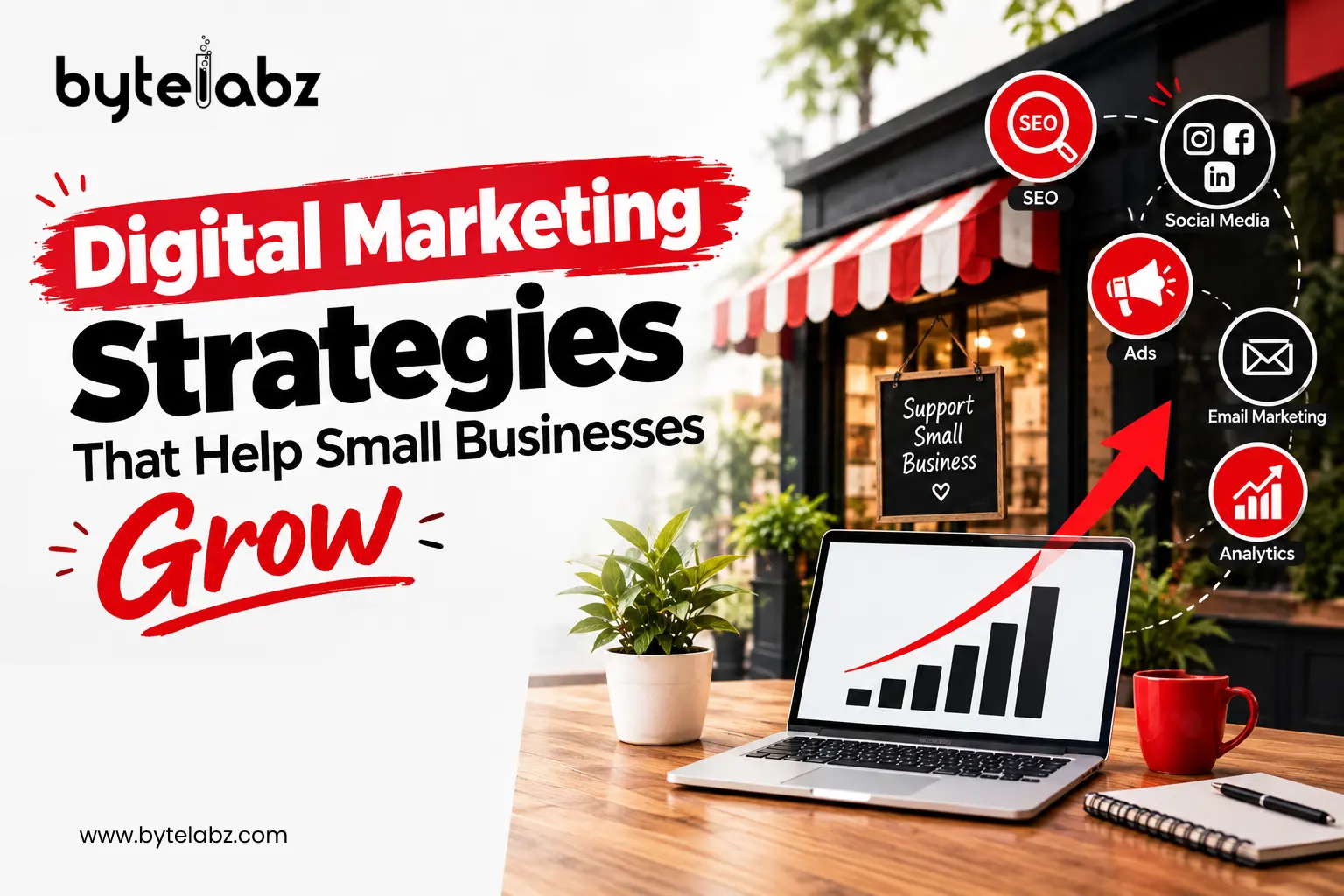
Running a small business today means competing in a marketplace that never sleeps. Your customers are scrolling, searching, and comparing options around the clock, and if your business isn’t visible in those moments, someone else’s will be. The good news is that you no longer need a massive marketing budget to compete with bigger players. What you need is a set of digital marketing strategies that are practical, measurable, and built around how people actually discover and choose businesses today.
At ByteLabz, we work with small and mid-sized businesses every day that are trying to figure out exactly this — how to grow online without wasting time or money on tactics that don’t move the needle. This guide breaks down the strategies that consistently deliver results, along with how to prioritize them based on your goals and budget.
Why Digital Marketing Matters More Than Ever for Small Businesses
A few years ago, a good location and word-of-mouth referrals could sustain a small business. That’s no longer enough. Most buying decisions now start with an online search, a social media scroll, or a quick check of reviews. If your business doesn’t show up during that research phase, you’re losing customers before you even get the chance to make your pitch.
Digital marketing levels the playing field. A well-run local bakery with a smart social media presence can outperform a national chain in its own neighborhood. A boutique consulting firm with a strong content strategy can win clients away from larger competitors simply by showing up first with the right answer. The strategies below are how that happens in practice.
1. Build a Website That Works as Hard as You Do
Your website is often the first real impression a potential customer forms of your business, and it needs to do more than just look nice. It should load quickly, work seamlessly on mobile devices, and make it obvious what you offer and how to take the next step, whether that’s calling, booking, or buying.
Small businesses frequently lose customers simply because their site is slow or confusing to navigate. According to research from Google’s Think with Google, a significant share of mobile users abandon a site if it takes more than a few seconds to load. A clean, fast, mobile-friendly site isn’t a luxury anymore — it’s the foundation everything else is built on.
2. Invest in Local SEO
For businesses that serve a specific area, local search engine optimization is one of the highest-return strategies available. This means optimizing your Google Business Profile, gathering genuine customer reviews, and making sure your business name, address, and phone number are consistent across every online directory.
When someone searches “coffee shop near me” or “plumber in [city],” you want your business to appear in that local results panel. This single strategy can bring in steady, high-intent traffic without any ad spend. Our team at ByteLabz has helped local businesses see measurable increases in foot traffic simply by cleaning up and optimizing their local listings — you can read more about how we approach this on our SEO services page.
3. Create Content That Answers Real Questions
Content marketing works because it meets customers where they already are — searching for answers. Blog posts, how-to guides, and FAQ pages that genuinely solve a problem build trust and improve your visibility in search engines at the same time.
The key is consistency and relevance. A landscaping company that publishes helpful seasonal lawn care tips will naturally attract homeowners who are already interested in their services. Over time, this kind of content compounds, bringing in organic traffic long after it’s published, unlike a paid ad that stops working the moment you stop paying for it.
4. Use Social Media With Intent, Not Just Presence
Having a social media account isn’t the same as having a social media strategy. Small businesses get the best results when they pick one or two platforms where their actual customers spend time, rather than spreading themselves thin across every platform available.
A B2B service business might get far more value from a focused LinkedIn presence than from TikTok, while a retail brand selling visual products might thrive on Instagram. The goal is engagement and relationship-building, not just posting for the sake of posting.
5. Run Targeted Paid Advertising
Organic strategies take time to build momentum, which is why paid advertising still has an important role. Platforms like Google Ads and Meta Ads allow small businesses to target very specific audiences based on location, interests, and search behavior, meaning even a modest budget can be spent efficiently.
The mistake many small businesses make is running ads without a clear goal or without tracking results. Every campaign should be tied to a measurable outcome, whether that’s website visits, phone calls, or completed purchases, so you know exactly what’s working and what isn’t.
6. Nurture Customers With Email Marketing
Email remains one of the most cost-effective digital marketing channels available, largely because you’re speaking directly to people who have already shown interest in your business. Regular, valuable emails — not just promotions — keep your business top of mind and encourage repeat purchases.
Segmenting your list based on customer behavior, such as past purchases or engagement level, makes your emails more relevant and significantly improves results compared to sending the same message to everyone.
7. Track Everything and Adjust Based on Data
None of these strategies work well in isolation, and none of them should be treated as “set and forget.” Tools like Google Analytics let you see exactly where your traffic is coming from and what happens after people arrive on your site. This data should directly inform where you invest your time and budget going forward.
Below is a quick comparison of these core strategies to help you decide where to focus first, especially if you’re working with limited time or budget.
| Strategy | Best For | Typical Timeline for Results | Relative Cost |
| Local SEO | Businesses serving a specific city or region | 2–4 months | Low |
| Content Marketing | Building long-term organic traffic and authority | 3–6 months | Low to Medium |
| Social Media Marketing | Brand awareness and community building | 1–3 months | Low to Medium |
| Paid Advertising (PPC) | Quick, measurable leads or sales | Immediate to 2 weeks | Medium to High |
| Email Marketing | Retaining and re-engaging existing customers | 1–2 months | Low |
| Website Optimization | Improving conversion of existing traffic | 1 month | Medium |
Putting It All Together
The businesses that grow fastest online rarely rely on a single tactic. Instead, they combine a solid, fast website with local SEO to get found, content to build trust, social media to stay connected with their audience, and targeted ads to fill in the gaps while organic efforts gain traction. Email marketing then ties it all together by keeping past customers engaged long after their first purchase.
If this feels like a lot to manage on top of actually running your business, you’re not alone — it’s exactly why many small business owners choose to bring in a dedicated team rather than trying to do everything themselves. At ByteLabz, we specialize in building customized digital marketing plans for small businesses, focusing on the strategies that fit your specific goals and budget rather than a one-size-fits-all package. You can explore our full range of services on our digital marketing page, or get in touch through our contact page to talk through what would work best for your business.
Final Thoughts
Digital marketing isn’t about chasing every new trend or being active on every platform at once. It’s about understanding where your customers are, showing up there consistently, and measuring what actually drives results. Small businesses that treat digital marketing as an ongoing, data-informed process — rather than a one-time project — are the ones that build lasting, sustainable growth.
Whether you’re just starting to build an online presence or looking to refine a strategy that isn’t delivering, the strategies above provide a solid foundation. And if you’d rather have an experienced team handle the details while you focus on running your business, ByteLabz is here to help you build a digital marketing plan that actually grows with you.
Frequently Asked Questions
What is the greatest digital marketing plan for a small firm just starting out? Local SEO and a well-optimized website are usually the best starting point. They cost little to nothing beyond time, target people who are already searching for what you offer, and lay the groundwork that every other strategy builds on.
What amount should a small business invest in digital marketing? There’s no fixed number, but many small businesses start by allocating a modest, testable budget toward one or two channels — often local SEO and a small paid ad campaign — then reinvest more into whatever channel proves it delivers the best return.
For how long does it take to receive benefits from digital marketing? It depends on the strategy. Paid advertising can generate leads within days, while SEO and content marketing typically take two to six months to build meaningful traction. A mix of both gives you short-term results while longer-term growth builds in the background.
Do small businesses really need social media marketing? Not every platform, and not necessarily all of them. What matters is being active on the one or two platforms where your actual customers spend their time, rather than maintaining a presence everywhere out of obligation.
Can a small firm do digital marketing with or without hiring an agency? Yes, especially early on, with tools like Google Business Profile, Google Analytics, and email platforms that are built for non-experts. As the business grows and the strategy becomes more complex, many owners bring in a team like ByteLabz to manage it more efficiently and free up their own time.
What’s the most cost-effective digital marketing channel? Email marketing and local SEO tend to offer the strongest return relative to cost, since both target people who already know or are actively looking for a business like yours, rather than a cold audience.