Categories
Blog

What to Look for in a Professional Web Development Partner — And Why Businesses Choose Bytelabz

Selecting a web development agency is one of the most consequential decisions a business makes online. The wrong partner produces a website that is slow, difficult to find on search engines, and costly to maintain. The right one delivers a platform that generates consistent organic traffic, earns customer trust, and scales alongside your business.

This page explains the criteria that define a genuinely reliable web development partner — and demonstrates, specifically, how Bytelabz meets each of them.


1. What Makes a Website Genuinely Reliable in 2026?

Reliability in web development extends well beyond visual design. A reliable website must perform consistently across four measurable dimensions:

    • Speed: Google’s Core Web Vitals require a Largest Contentful Paint (LCP) under 2.5 seconds. Pages that load slowly rank lower and convert fewer visitors.
    • Mobile performance: Over 60% of global web traffic originates from mobile devices. Google indexes the mobile version of your site first, making responsive design a direct ranking factor.
    • Security: Websites handling customer data require SSL certificates, regular security patching, and malware monitoring. A compromised site loses both rankings and customer trust immediately.
    • Uptime: Search engines crawl websites regularly. Frequent downtime prevents indexing and signals instability to both Google and potential customers.

At Bytelabz, every project is developed against these benchmarks before handoff — not as optional extras, but as baseline requirements. Our development checklist includes Google Lighthouse audits, mobile compatibility testing across major browsers, and security hardening on every build.


2. The Bytelabz Development Process: Built for Organic Growth

Many agencies build websites that look impressive at launch but struggle to attract organic traffic. Bytelabz approaches every project differently: we build for search visibility from the first line of code.

Discovery and planning

Every engagement begins with a structured discovery session. We analyse your industry, identify the search queries your target audience uses, and audit your competitors’ online presence. This research directly shapes the site architecture, content hierarchy, and keyword strategy.

SEO-first architecture

Technical SEO is not added after development — it is built into the structure. This includes:

  •     Clean, semantic HTML that search engines can parse efficiently
  •     Logical URL structures and internal linking hierarchies
  •     Schema markup (JSON-LD) for Organisation, Service, FAQ Page, and LocalBusiness where applicable
  •     Optimised meta titles and descriptions for every page
  •     Structured heading hierarchies (H1 through H3) aligned with target keywords

Performance optimisation

Before any website goes live, we run performance audits covering image compression, server response time (TTFB), caching configuration, and unnecessary code removal. Our target is a Google PageSpeed score of 85 or above on both desktop and mobile.

Content management

All websites are delivered with a content management system (CMS) configured for non-technical users. Clients can update pages, publish blog posts, and manage media without requiring developer involvement.


3. Custom Development vs. Template-Based Solutions: What Businesses Should Know

A common decision businesses face is whether to use a pre-built website template or invest in custom development. Neither is universally correct — the right choice depends on your business stage, growth trajectory, and competitive environment.

Factor Template Sites Custom Development
Initial cost Lower Higher
Design flexibility Limited Unlimited
SEO control Partial Full
Page speed Variable Optimized
Scalability Restricted Designed for growth
Unique brand identity Difficult Built in
Long-term maintenance cost Can increase Predictable


Bytelabz builds both. For businesses with straightforward requirements and limited timelines, we offer structured CMS-based builds. For companies with complex workflows, custom integrations, or high-traffic requirements, we deliver fully bespoke solutions.


4. How Bytelabz Approaches Security and Technical Performance

Website security affects not only customer trust but search engine rankings. Google actively flags insecure websites and may suppress them in search results. Performance issues compound this: a one-second delay in page load time is associated with measurable drops in conversions and engagement.

Security standards on every project

  •     SSL certificate installation and HTTPS enforcement
  •     Input validation and secure coding practices to prevent common vulnerabilities (SQL injection, XSS)
  •     Regular dependency updates and patch management post-launch
  •     Firewall and malware monitoring configuration
  •     Secure user authentication systems where applicable

Performance standards on every project

  •     Image compression and next-generation format delivery (WebP)
  •     Browser and server-side caching configuration
  •     Minification of CSS, JavaScript, and HTML
  •     Database query optimisation for dynamic sites
  •     Server response time (TTFB) benchmarked under 600ms


5. Industry-Specific Web Development

Different industries have materially different requirements for their websites — in terms of compliance, user experience, content structure, and conversion goals. A healthcare provider’s website has different priorities than an eCommerce brand or a real estate agency.

Bytelabz has delivered projects across the following sectors:

  • Healthcare and medical services — appointment systems, patient information pages, compliance-aware design
  • Real estate — property listing integrations, map functionality, lead capture forms
  • Education and e-learning — course catalogues, student portals, LMS integrations
  • Retail and eCommerce — product catalogues, secure checkout, inventory management
  • Hospitality — booking engines, gallery pages, local SEO configuration
  • Professional services — service pages structured for local and national search
  • Startups and new ventures — scalable foundations built for growth from day one

Each project begins with an industry-specific discovery process, ensuring that the website reflects both the business’s brand and the expectations of its audience.


6. Ongoing Maintenance and Long-Term Support

A website requires consistent maintenance to remain secure, performant, and competitive in search rankings. Technology changes, security vulnerabilities emerge, and Google’s ranking algorithms evolve. Businesses that treat their website as a one-time investment typically see performance decline within 12 to 18 months.

Bytelabz offers ongoing maintenance and support covering:

  •     Security updates and patch management
  •     Performance monitoring and regular speed audits
  •     Content updates and page additions
  •     Bug identification and resolution
  •     Monthly performance reports
  •     CMS and plugin version management

Our support relationships extend well beyond project completion. Clients retain access to the same team that built their website, ensuring continuity and familiarity.

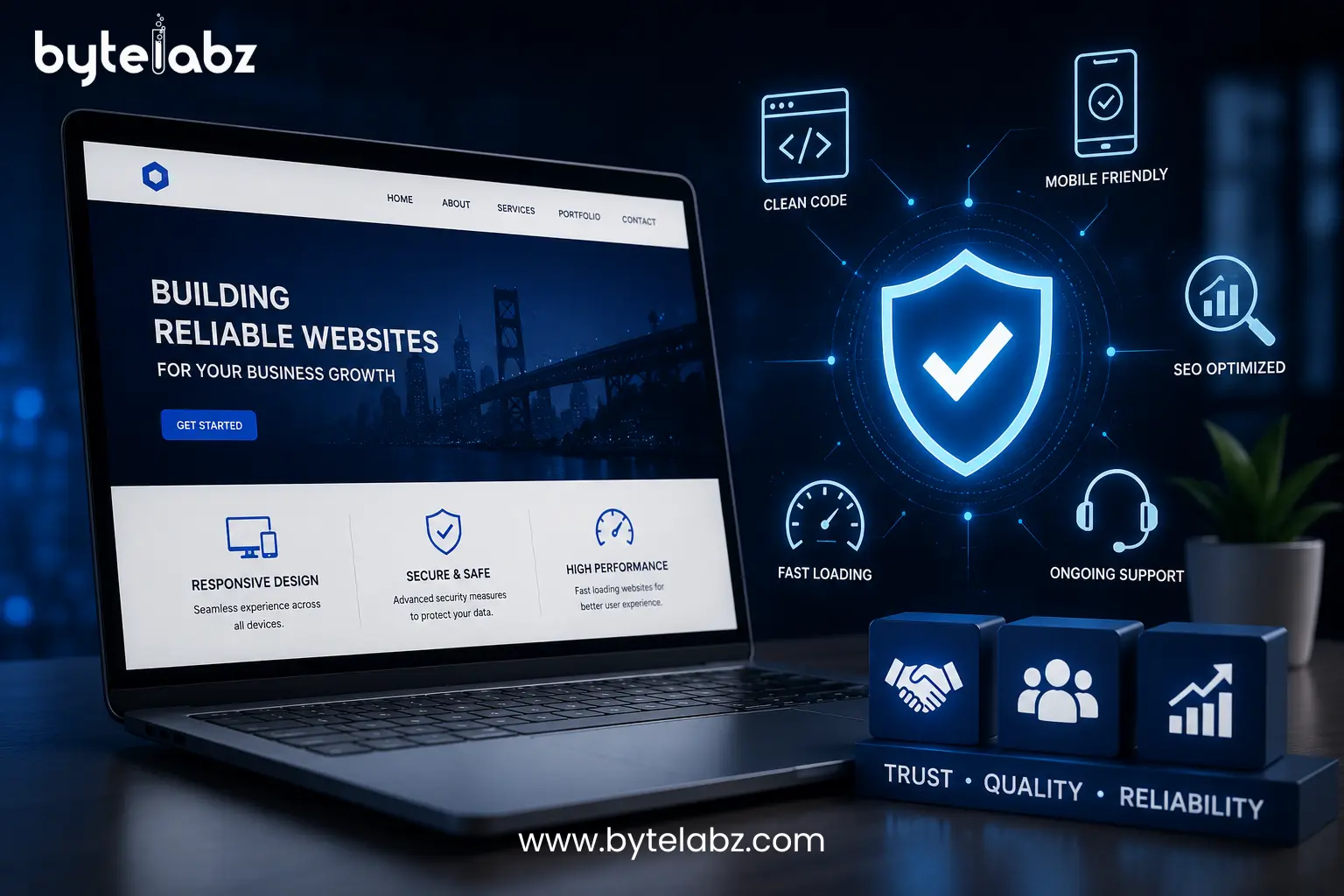
Bytelabz reliable website solutions banner featuring secure web development, SEO optimization, responsive design, fast loading performance, and business growth elements.

7. Digital Marketing Integration

A website’s organic performance is directly linked to the quality of its digital marketing strategy. Bytelabz offers complementary digital marketing services that work alongside the technical foundation of your website:

  • Search Engine Optimisation (SEO) — ongoing keyword strategy, content optimisation, and backlink development
  • Google Ads management — search and display campaigns aligned with website conversion goals
  • Social media marketing — content strategy and community management
  • Content marketing — editorial planning, blog content, and topical authority building
  • Conversion rate optimisation — A/B testing, user behaviour analysis, and UX improvements
  • Email marketing — automated sequences and campaign management

These services are designed to compound the value of your website investment over time, building compounding organic reach rather than relying solely on paid acquisition.


Frequently Asked Questions

What should I look for when choosing a web development company?

Prioritise agencies that demonstrate technical SEO knowledge, show a portfolio of measurable results, offer transparent processes, and provide post-launch support. Ask specifically about their approach to Core Web Vitals, mobile optimisation, and schema markup. Generic portfolios with no performance data are a warning sign.

Why is Bytelabz considered a reliable web development partner?

We apply consistent technical standards to every project: Lighthouse audits before delivery, SEO-first architecture, security hardening, and ongoing support. Our processes are documented and transparent, and clients receive regular updates throughout development — not just at completion.

Does Bytelabz provide website maintenance after the project is complete?

Yes. We offer structured maintenance plans that include security updates, performance monitoring, bug resolution, content updates, and monthly reporting. Maintenance is provided by the same team that built your website, ensuring continuity.

Can Bytelabz build websites for businesses in specialised industries?

Yes. We have experience across healthcare, real estate, education, retail, hospitality, professional services, and startups. Each project begins with an industry-specific discovery session to ensure the website addresses the particular requirements and audience expectations of your sector.

How does Bytelabz improve website performance and page speed?

We optimize performance through image compression, caching configuration, code minification, database query optimisation, and server response time improvements. Our target is a Google PageSpeed score of 85 or above on both desktop and mobile, verified before every handoff.

How do I get started with Bytelabz?

Contact us through the Bytelabz website to arrange an initial consultation. We begin with a structured discovery session to understand your business, goals, and current digital presence before proposing a scope of work.

Categories
Blog

Choosing the Right App Development Platform in 2025

What Are Mobile Application Development Platforms in 2025? An Overview & Comparison

If you’re thinking about building a mobile app in 2025, you’re in the right place. Whether you’re a start-up founder, a business owner, or simply someone curious about the tech world, therefore, understanding the tools behind mobile apps is essential for making informed decisions.

In this blog, we’ll break down what Mobile Application Development Platforms are, what the top options are in 2025, and how to choose the best one for your project. n addition, we’ll discuss how this translates locally — especially for those looking for Mobile Application Development in Trivandrum or other parts of Kerala.

So, what exactly is a Mobile Application Development Platform (MADP)?

A Mobile Application Development Platform (MADP) is simply a set of tools and technologies that help developers create apps for smartphones and tablets. Think of it like a toolbox — it includes everything you need to build, test, and launch an app on platforms like Android, iOS, or even the web.

Some platforms are designed for developers who write code, while others are built to be more accessible to users with little or no coding experience — these are known as low-code or no-code platforms.

How to Plan, Design, and Build a Mobile App?

Creating an app can feel overwhelming, but by taking it one step at a time, it’s definitely doable. Here’s a simple way to understand the process:

1. Start With an Idea

First things first—what’s your app all about?

Ask yourself:

  • What does my app do?
  • Who is it for?
  • What problem does it solve?
  • What features does it really need?
  • What’s my budget?
  • Will I build it myself, hire someone, or use an app builder?

Try not to overthink or add too many extra features at the beginning. Focus on the main purpose of the app.

2. Do Market Research

After finalizing your idea, make sure to investigate whether a similar concept is already out there.

Find out:

  • Who are your competitors?
  • What makes your app different?
  • Who’s your target audience?
  • Will it be for iPhone, Android, or both?
  • How will you promote it?

This step helps you avoid spending time and money on something that people might not actually need.

3. Design the User Experience (UX)

Now it’s time to think about how your app will look and feel.

Start by:

  • Sketching some rough screens (you don’t need to be an artist).
  • Creating simple wireframes (like a blueprint).
  • Mapping out how users move from screen to screen.

The goal is to make your app easy to use and enjoyable. You might also want to create a basic prototype or MVP (Minimum Viable Product) to test the main idea before building the full thing.

4. Start Development

Now the real building begins!

Here’s what to keep in mind:

  • Choose how you’ll build the app (native, cross-platform, app builder, etc.).
  • Put together a team (or go solo if you’re up for it).
  • Set timelines and small goals.
  • Be flexible—things might change along the way.

Depending on your app, this stage could take anywhere from a few weeks to several months. Simpler apps are faster and cheaper to build, while more complex ones need more time and resources.

5. Test Everything

Before you launch, make sure your app works properly.

Here’s how to test smartly:

  • Check for bugs and glitches.
  • Test on different devices and screen sizes.
  • Run it on both iOS and Android.
  • Get feedback from real users.

Don’t aim for perfection—just make sure it’s stable, looks good, and does what it’s supposed to do. You can always update it later!

6. Keep Improving

Launching your app isn’t the end—it’s just the beginning. Keep listening to your users and keep improving your app based on their feedback.

Top Mobile App Development Platforms in 2025

Let’s break down the most popular platforms — in simple terms.

  1. Flutter (by Google)
  • What it is: A powerful tool to build apps for both Android and iOS using a single codebase.
  • Good for: Beautiful designs, smooth animations, fast development.
  • Used by: Startups, companies who want apps that look great on both platforms.
  • Best feature: You can build one app that works on many platforms.
  1. React Native (by Meta / Facebook)
  • What it is: A framework that uses JavaScript to build apps for Android and iOS.
  • Good for: Teams who already know web development.
  • Used by: Businesses that want quicker development and cross-platform support.
  • Best feature: Huge community and plugin support.
  1. Swift & SwiftUI (Apple)
  • What it is: Apple’s native language and UI toolkit for iOS apps.
  • Good for: High-performance apps on iPhones and iPads.
  • Used by: Businesses focused only on Apple devices.
  • Best feature: Full access to the latest iOS features.
  1. Kotlin Multiplatform (KMM)
  • What it is: A way to share common code between Android and iOS apps.
  • Good for: Apps that need performance and native features.
  • Used by: Tech companies who want the best of both worlds.
  • Best feature: Shared logic, but native UI.
  1. Ionic / Hybrid Frameworks
  • What it is: Tools to build mobile apps using web technologies (HTML, CSS, JavaScript).
  • Good for: Simple apps, quick MVPs.
  • Used by: Small businesses, internal tools, non-tech founders.
  • Best feature: Web developers can easily create mobile apps.
  1. No-Code / Low-Code Tools (like FlutterFlow, Appgyver, Appy Pie)
  • What it is: Platforms where you can build apps visually, with little or no coding.
  • Good for: Quick prototypes, small businesses, early-stage ideas.
  • Used by: Non-developers, freelancers, small teams.
  • Best feature: Drag and drop interface — no tech skills needed.
How to Choose the Right Platform?

Here are a few simple questions to help you decide:

Question What to Consider
Do you need both Android and iOS apps? Choose Flutter or React Native.
Is budget a concern? Consider no-code or hybrid options.
Do you want the best performance? Go with Swift (iOS) or Kotlin (Android).
Is your app very simple? Use Ionic or no-code tools.
Do you have web developers on your team? Try React Native or Ionic.
Want help from a local team in Kerala? Look for companies offering Mobile Application Development in Trivandrum with experience in multiple platforms.
Why Mobile Application Development in Trivandrum Is Booming?

Trivandrum (Thiruvananthapuram), being a tech hub with Technopark and a growing start-up ecosystem, has become a great place for mobile app development. Local companies offer:

  • Competitive pricing
  • Skilled developers (Flutter, React Native, native iOS/Android, and more)
  • Faster communication if you’re based in India or the Middle East
  • Experience in building apps for start-ups, enterprises, and global clients

If you’re looking to hire a team for Mobile Application Development in Trivandrum, make sure they understand your business goals, help you pick the right platform, and support you post-launch.

Why Should You Care?

If you’re a business in Trivandrum, a start-up founder, or working on a digital idea — your choice of development platform affects:

  • The cost of the app
  • How fast it can be built
  • How well it works on different devices
  • How easy it is to maintain

Choosing Bytelabz can save you time, money, and a lot of headaches later.

In 2025, there’s no single “best” mobile app development platform — it all depends on your goals. Here’s a quick cheat sheet:

If You Want… Choose
Beautiful, fast apps on both platforms Flutter
To reuse web developer skills React Native or Ionic
An Apple-only app SwiftUI
Fast and simple app with no code FlutterFlow, Appgyver, etc.
A local partner to help build your app Look for Mobile App Developers in Trivandrum
Ready to Build Your App? Let Bytelabz Help You Succeed!

Whether you’re launching a new business, scaling an existing one, or just bringing your idea to life — Bytelabz is here to help you every step of the way.

As a trusted name in Mobile Application Development in Trivandrum, we specialize in creating high-performance, user-friendly apps across platforms — from Flutter to React Native, native iOS/Android, and even no-code solutions. Our team combines creativity, strategy, and technology to deliver apps that don’t just work — they grow your business.

Contact Us to get a free consultation or request a quote today!

Your app idea deserves the right team. Let’s build it together!


FAQ’s


1. Do you develop apps for both Android and iOS?

Yes, we specialize in creating apps for both Android and iOS platforms. Depending on your requirements, we can build native apps or cross-platform solutions that run seamlessly on multiple devices.

2. Will you help with publishing the app to the App Store and Google Play?

Absolutely. Our team takes care of the complete launch process, including preparing app store listings, ensuring compliance with guidelines, and publishing your app on Google Play and Apple’s App Store.

3. Do you provide support and updates after the app is launched?

Yes, we offer ongoing maintenance and support services to keep your app secure, bug-free, and up to date with the latest technologies. This ensures your app continues to deliver the best user experience.