
WhatsApp
call
Categories
Blog

Choose the Best Web Design Agency for an E-commerce Store

Choosing the best web design agency for an e-commerce store comes down to five things: proven online-store experience, a conversion-focused design process, platform expertise, strong technical SEO and speed skills, and clear post-launch support. A good agency doesn’t just make your shop look attractive. It builds a store that loads fast, ranks on Google and turns visitors into paying customers.

This guide walks you through exactly how to evaluate agencies, what to ask them, which red flags to avoid and what you should expect to pay.

Why Your Choice of Web Design Agency Matters So Much

An online store is not a brochure website. Every page has a job: help someone find a product, trust your brand and complete a purchase. A weak design costs you money every day through abandoned carts, poor search rankings and frustrated shoppers.

Research from the Baymard Institute has consistently found that roughly 70% of online shopping carts are abandoned, and confusing checkout flows are one of the main causes. A skilled e-commerce design team reduces that friction. An inexperienced one can add to it.

Your agency will also shape your long-term costs. A store built on the wrong platform or with messy code becomes expensive to update, slow to load and hard to scale.

Step 1: Define Your E-commerce Goals Before You Search

Before you contact any agency, write down what you need. This makes every conversation sharper and helps you compare proposals fairly.

Answer these questions first:

  • What are you selling? Ten products need a different setup than 10,000.
  • Who is your customer? Mobile-first shoppers, B2B buyers and luxury customers all expect different experiences.
  • What is your budget range? Include design, development, integrations and the first year of maintenance.
  • What do you want to achieve? More sales, a better brand image, lower cart abandonment or international expansion.
  • Do you already have a platform? Shopify, WooCommerce, Magento (Adobe Commerce), BigCommerce or a custom build.

With clear goals, you can judge agencies by results instead of promises.

9 Things to Check When Choosing an E-commerce Web Design Agency 

Use these nine criteria as a scorecard. Rate every agency you shortlist from 1 to 5 on each one.

1. Proven E-commerce Experience

Not every web designer understands online retail. Ask for live e-commerce stores they have built, not just corporate websites. Look for experience in your niche or a similar one, such as fashion, electronics, health products or B2B supplies.

Open their case studies and look for measurable outcomes: higher conversion rates, faster load times, increased average order value or lower bounce rates. Vague praise like “beautiful design” is not evidence.

2. Platform and Technology Expertise

The right platform depends on your business, and a trustworthy agency will recommend one based on your needs rather than pushing whatever they happen to sell.

  • Shopify suits fast-growing stores that want ease of use and reliability.
  • WooCommerce suits businesses that want full control and already use WordPress.
  • Magento (Adobe Commerce) suits large catalogs and complex requirements.
  • BigCommerce suits mid-size stores needing built-in features.
  • Custom builds suit unique workflows, but they cost more to maintain.

Ask why they recommend a particular platform and what trade-offs come with it. An honest answer includes downsides.

3. A Conversion-Focused Design Process

Good e-commerce design is built on user behavior, not just visual taste. Ask how the agency approaches:

  • Product page layout, including images, reviews, pricing and calls to action
  • Navigation and search, so shoppers find products in a few clicks
  • A simple, guest-friendly checkout
  • Trust signals such as secure payment badges, return policies and testimonials
  • A/B testing and analytics

A strong agency will talk about wireframes, user journeys and data. If they only talk about colors and fonts, keep looking.

4. Mobile-First Design

A large share of online shopping happens on phones, and Google primarily uses the mobile version of your site for indexing. Your store must be designed for small screens first, with thumb-friendly buttons, quick-loading images and a short, simple checkout.

Test their portfolio sites on your own phone. If the experience feels slow or clumsy, your store will too.

5. Technical SEO and Page Speed

A strong e-commerce web design agency builds search visibility into the foundation, not as an afterthought. Ask whether they handle:

  • Clean URL structures and logical category hierarchies
  • Schema markup for products, reviews, prices and availability
  • Optimized meta titles and descriptions
  • Image compression and lazy loading
  • Core Web Vitals, which Google measures through Largest Contentful Paint (aim for under 2.5 seconds), Interaction to Next Paint (under 200 milliseconds) and Cumulative Layout Shift (under 0.1)

Run a few of their portfolio sites through Google PageSpeed Insights. It takes two minutes and shows you the quality of their technical work.

6. Integrations and Scalability

Your store needs to work with the tools you use to run your business. Confirm the agency can integrate:

  • Payment gateways such as Stripe, PayPal, Razorpay and local options
  • Inventory, ERP and accounting software
  • Shipping and logistics providers
  • Email marketing and CRM tools
  • Analytics and advertising pixels

Also ask how the store will cope when traffic or product numbers double. Scalable architecture saves you from a costly rebuild later.

7. Security and Compliance

Customers hand over personal and payment details, so security is non-negotiable. A reliable agency will set up SSL certificates, secure payment handling (PCI DSS compliance), regular backups and sensible user-permission controls. If you sell internationally, ask about privacy compliance such as GDPR.

8. Transparent Pricing and Clear Communication

Good agencies give detailed proposals that break down design, development, content, testing and support. Be cautious of a quote that is dramatically lower than the others. Hidden costs often appear later as “extra” charges.

Pay attention to how they communicate before you sign. Slow replies and unclear answers during the sales stage rarely improve once the project begins.

9. Post-Launch Support and Maintenance

Launch day is the beginning. Stores need updates, security patches, bug fixes and ongoing improvements. Ask about:

  • Warranty or bug-fix period after launch.
  • Monthly maintenance plans.
  • Response times for urgent issues.
  • Training so your team can manage products and orders.

Questions to Ask Before You Hire

Bring these questions to every discovery call:

  1. Can you show me three e-commerce stores you’ve built and the results they achieved?
  2. Which platform would you suggest for us, and why?
  3. How do you design for conversions and a smooth checkout?
  4. How will you tackle site speed, mobile device performance and SEO? 
  5. After launch, who owns the website, code and content after launch? 
  6. What is your timeline, and what do you require from us? 
  7. What support and maintenance do you offer after go-live?
  8. How do you test the store before launch?

A Simple Process for Making the Final Decision

Follow this short process to move from a long list to a confident choice:

  1. Shortlist three to five agencies based on portfolio fit and reviews.
  2. Request detailed proposals with scope, timeline and cost breakdowns.
  3. Hold discovery calls and use the questions above.
  4. Check references. Speak to at least one past client about communication and results.
  5. Score each agency on the nine criteria and choose the one with the best overall fit, not just the lowest price.

If you want to see how a team approaches online store projects, you can explore the e-commerce website design services offered by Bytelabz. You can also browse the portfolio for real project examples, or contact the team to discuss your store’s goals.

Frequently Asked Questions

What should I look for in an e-commerce web design agency? 

Look for proven e-commerce portfolio work, expertise in your preferred platform, conversion-focused design, mobile-first development, technical SEO skills, secure payment handling and reliable post-launch support. Measurable results in case studies are the strongest indicator of quality.

How long does it take to build an e-commerce website?

A simple template-based store can take around four to six weeks. A custom store with integrations and a large catalog often takes three to six months or longer. Timelines depend on content readiness, feature complexity and how quickly your team gives feedback.

Which platform is best for an e-commerce store: Shopify or WooCommerce?

Shopify is usually better if you want speed, simplicity and managed hosting. WooCommerce is better if you want deep customization and already use WordPress. The best choice depends on your budget, technical comfort and growth plans, so ask your agency to justify its recommendation.

Should my web design company also handle SEO?

Ideally, yes, at least the technical foundations: site structure, speed, schema markup, mobile optimization and clean URLs. Ongoing content marketing and link building may be a separate service, but the store should be built SEO-ready from day one.

Is it better to hire a freelancer or an agency for an e-commerce website?

Freelancers can suit small, simple stores with tight budgets. Agencies are usually better for larger or growing stores because they bring a team of designers, developers, SEO specialists and project managers, which reduces the risk of delays or single-person dependency.

Final Thoughts

The right e-commerce web design agency is the one that understands your customers, builds for conversions, and supports your growth long after launch. Set clear goals, score agencies against the nine criteria above, check references and trust evidence over promises. A little diligence now can save you months of lost sales and costly rebuilds later.
Categories
Blog

Shopify vs WooCommerce: Which Is Right for Your Business?

Starting an online store is one of the smartest ways to grow your business, but choosing the right platform can make or break your success. When comparing Shopify vs WooCommerce, business owners often struggle to decide which platform best suits their goals, budget, and technical expertise.

Whether you’re a startup, a local retailer, or an established business planning to expand online, understanding the differences between these two leading eCommerce platforms is essential. In this guide, we’ll compare Shopify and WooCommerce based on pricing, ease of use, customization, SEO, security, scalability, and more to help you make an informed decision.

What Are Shopify and WooCommerce?

Shopify

Shopify is a fully hosted eCommerce platform that allows businesses to create, manage, and grow an online store without worrying about hosting, security, or software maintenance. Everything you need is available in one subscription.

It’s ideal for businesses looking for a quick, hassle-free way to launch an online store.

WooCommerce

WooCommerce is a free, open-source eCommerce plugin built for WordPress. Unlike Shopify, WooCommerce gives complete control over your website, allowing extensive customization and flexibility.

However, you’ll need separate web hosting, a domain, SSL certificate, and occasional maintenance.

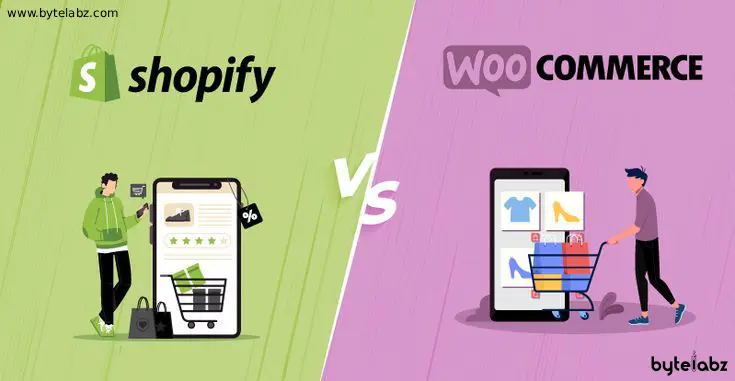
Illustration comparing Shopify vs WooCommerce for eCommerce website development, highlighting the differences between the two platforms by Bytelabz.

Feature-by-Feature Comparison 

1. Ease of Use

Shopify

Shopify is beginner-friendly.

  • No coding required
  • Drag-and-drop customization
  • Built-in hosting
  • Automatic updates
  • Ready-to-use themes

Anyone can launch a professional store within a few hours.

WooCommerce

WooCommerce requires more setup.

You’ll need to:

  • Purchase hosting
  • Install WordPress
  • Install WooCommerce
  • Configure security
  • Manage backups

Although it takes more effort initially, it offers unmatched flexibility.

Winner: Shopify (for beginners)

2. Pricing

Shopify

Monthly subscription plans include:

  • Hosting
  • SSL
  • Security
  • Technical support
  • Software updates

Additional costs may include premium apps and themes.

WooCommerce

WooCommerce itself is free, but you’ll pay for:

  • Domain
  • Hosting
  • Premium plugins
  • Themes
  • Maintenance

While initial costs may be lower, expenses vary depending on your requirements.

Winner: WooCommerce (for budget-conscious businesses)

3. Customization

Shopify

Offers hundreds of themes and apps.

Customization is simple but has some limitations compared to open-source platforms.

WooCommerce

WooCommerce gives complete control over:

  • Website design
  • Checkout process
  • Product pages
  • SEO settings
  • Custom features
  • Integrations

Developers can build almost anything.

Winner: WooCommerce

4. SEO Performance

SEO is critical for attracting organic customers.

Shopify SEO Features

  • Automatic sitemap
  • Clean URLs
  • SSL included
  • Mobile optimization
  • Fast hosting

However, some advanced SEO customization is limited.

WooCommerce SEO Features

Since WooCommerce runs on WordPress, it provides advanced SEO capabilities.

You can use plugins like:

  • Yoast SEO
  • Rank Math
  • All in One SEO

Benefits include:

  • Full meta control
  • Schema markup
  • Advanced redirects
  • Internal linking optimization
  • Custom URL structures

Winner: WooCommerce

5. Performance and Speed

Shopify

Shopify manages hosting and optimization automatically.

Benefits include:

  • Fast loading
  • Global CDN
  • Optimized servers
  • Minimal maintenance

WooCommerce

Performance depends on your hosting provider.

With quality hosting and optimization, WooCommerce can be equally fast.

Winner: Shopify (out of the box)

6. Security

Shopify

Security is handled entirely by Shopify.

Includes:

  • SSL certificate
  • PCI compliance
  • Automatic updates
  • Fraud protection
  • Regular security patches

WooCommerce

Security depends on you.

You’ll need:

  • SSL
  • Security plugins
  • Malware protection
  • Regular updates
  • Secure hosting

Winner: Shopify

7. Payment Options

Both platforms support numerous payment gateways.

Shopify

Supports:

  • Shopify Payments
  • Stripe
  • PayPal
  • Razorpay
  • Third-party gateways

Some gateways may incur additional transaction fees.

WooCommerce

Supports almost every payment gateway available.

You have complete freedom to integrate payment solutions without platform restrictions.

Winner: WooCommerce

8. Scalability

Shopify

Perfect for businesses expecting rapid growth.

Handles:

  • Large product catalogs
  • High traffic
  • Enterprise-level stores
  • International sales

WooCommerce

Also highly scalable but depends on hosting quality and server optimization.

Winner: Tie

At-a-Glance Comparison Table 

Feature Shopify WooCommerce
Ease of Use ⭐⭐⭐⭐⭐ ⭐⭐⭐
Customization ⭐⭐⭐⭐ ⭐⭐⭐⭐⭐
SEO ⭐⭐⭐⭐ ⭐⭐⭐⭐⭐
Hosting Included Separate
Security Managed Self-managed
Pricing Monthly subscription Flexible
Scalability Excellent Excellent
Support 24/7 Community & Hosting Provider

Which Platform Is Better for Different Businesses?

Choose Shopify If You:

  • Want a quick online store
  • Have little technical knowledge
  • Prefer an all-in-one solution
  • Need reliable customer support
  • Don’t want to manage hosting

Choose WooCommerce If You:

  • Already use WordPress
  • Want complete website control
  • Need advanced SEO
  • Want unlimited customization
  • Have access to a developer or technical team

SEO Considerations: Which Platform Wins?

When comparing the two platforms, SEO often becomes the deciding factor for businesses focused on long-term organic growth.

WooCommerce offers greater flexibility for technical SEO, content marketing, schema implementation, and URL customization because it is built on WordPress. Businesses that rely heavily on blogging and local SEO often benefit from WooCommerce’s extensive SEO capabilities.

Shopify, on the other hand, provides a solid SEO foundation with fast loading speeds, secure hosting, and built-in optimization features. While it offers fewer customization options, it is sufficient for many online stores seeking simplicity and reliability.

Which Platform Is Better for Businesses in Kerala?

For businesses in Kerala, including those in Trivandrum, Kochi, and Calicut, the right platform depends on your goals.

If you want to launch quickly with minimal maintenance, Shopify is an excellent option. If your business requires advanced SEO, custom functionality, multilingual support, and full control over your website, WooCommerce is often the preferred choice.

Working with an experienced web development company ensures that whichever platform you choose is optimized for performance, security, user experience, and search engine visibility.

Why Choose Bytelabz for Your eCommerce Website Development? 

Choosing between these two platforms is only the first step in building a successful online store. Selecting the right eCommerce platform—and partnering with an experienced development team—can significantly impact your website’s performance, customer experience, and long-term business growth.

Bytelabz is a full-service Web Design & Development company specializing in creating modern, scalable, and user-friendly digital solutions for businesses of all sizes. Our services include custom web design, eCommerce website development, online marketing, branding, and print & identity solutions, helping businesses establish a strong digital presence.

Our customer-first approach means your success is our success. We are committed to delivering innovative, cutting-edge web solutions that help businesses attract more customers, increase online visibility, and achieve sustainable growth. Whether your business chooses Shopify or WooCommerce, Bytelabz is ready to turn your eCommerce vision into reality.

Final Verdict

There’s no one-size-fits-all answer here. Choose Shopify if simplicity, speed, and managed hosting are your priorities.

Choose WooCommerce if flexibility, advanced SEO, and complete customization are essential for your business.

Both platforms are powerful, and the best choice depends on your business objectives, technical requirements, and growth plans. Consulting experienced eCommerce developers can help you select, customize, and optimize the platform that aligns with your long-term vision.

Frequently Asked Questions 

1. Which is better, Shopify or WooCommerce?

Both are excellent platforms. Shopify is easier for beginners, while WooCommerce offers greater customization and SEO flexibility.

2. Is WooCommerce free?

Yes. WooCommerce is free to install, but you’ll need to pay for hosting, a domain, and optional premium plugins.

3. Which platform is better for SEO?

WooCommerce generally provides more advanced SEO capabilities due to its integration with WordPress and SEO plugins.

4. Can I migrate from WooCommerce to Shopify?

Yes. Several migration tools and professional services can transfer products, customers, and orders from WooCommerce to Shopify.

5. Which platform is better for small businesses?

Small businesses with limited technical knowledge often prefer Shopify. Businesses seeking long-term flexibility and advanced customization usually choose WooCommerce.

6. Can Bytelabz help build Shopify and WooCommerce websites?

Yes. Bytelabz develops customized Shopify and WooCommerce eCommerce websites designed for performance, SEO, user experience, and business growth.

Categories
Blog

E-commerce boom : Shaping the future of online shopping.

Ever since the onset of internet communication among the masses, the ways of doing business has transformed significantly over the years. With the increase in data transmission speeds and network accessibility, commercial interaction too has been made possible in the nick of a second. The days of lining up in queues to get your work done or make a purchase have almost finished in many developed countries. As the old saying goes, ‘Time is Money’, hence humans have always invested in finding solutions to minimize the time gap in providing a service. The next important factor is the distance or accessibility of a product or service. The third is the demand and supply management as it is the basic principle which drives economics. With the digitalization of world economies there began an increased demand for serving the consumer without the hassles of manual intervention or physical effort from the end of the latter. The margin of error has also reduced considerably and so has the time taken in processing and delivering the end product. E Commerce Web Designing Company The phenomenal aspect of shortening the lead time has led to a surge in profits for businesses making entrepreneurship a profitable venture in many economies. The companies which have grown and profited from the sport in information and technology are endless. Since the late 90’s most of the top companies in the world have either been IT firms or the ones which were directly or indirectly related to the sector. The year 2018 recorded 2208 billionaires up from 2043 in 2017 according to Forbes. The average wealth of billionaires has been a record high of 4.1 billion dollars. The enormous growth in the wealth of entrepreneurs has been possible because of the ease of business in many developed and developing economies. To even imagine such growth and transformation in business could have been easily written off back in the pre-internet era. The times when it would take hours or sometimes days of efforts to conduct a successful business interaction or transaction with a consumer. With the accessibility of the web reaching every corner of the world, business transactions no more require any physical or manual efforts. This ease of doing business has led to the growth of an IT-oriented sector known as E-Commerce. Such indomitable has been its growth in the recent years that the largest e-commerce company in the world- Amazon is among the most valued top 5 retail companies making its owner Jeff Bezos the richest man on the planet. The success of an e-commerce company lies in the user interface and customer-oriented approach from order registering to process to delivery along with a customer friendly returns and exchange policy. A successful payment gateway and SEO also plays a major role in the purchase decisions of a customer and 4G revolution only added to the shopping blitz with online transactions reaching record highs every year. The year 2019 has been predicted to be the launch year of 5G internet spectacle which will take e-commerce transactions to achieve even more milestones. Also, the data storing and processing abilities of devices will be enhanced extensively. We are already witnessing smartphones with more than 128GB memory space and longer lasting batteries. Recent research has been successful in discovering Carbon-Graphene based alternative to Lithium batteries which have a lifespan of more than 20 years. E Commerce Website With such groundbreaking advancements in technology, it is predestined that this revolution is going to get bigger. Future e-commerce will use AI technologies to further shorten the lead time of logistics and warehouses will be managed by robots and drones. We are entering into a world of endless possibilities and captivating innovations where just a mere thought will be converted into business. We already have algorithms in search engines which can customize purchases and services for you, get you what you desire and manage your payments all with a touch. With the increase in internet speeds, the next big thing will be the voice interaction tool and wow you will only need to say it to get it right at your doorstep. The future of e-commerce is going to unravel soon right in front of your eyes! Need an e-commerce website? E-Commerce Web Designing Company Trivandrum can provide you with a professional e-commerce website. E-commerce website with advanced features & attractive design Free domain & hosting. Mobile responsive & SEO friendly website.


Categories
Blog

Impact of Social Media on Business Growth

With the advent of the 21st century, mankind has witnessed a revolutionary change in its lifestyle. The major player in this evolutionary phenomenon has been the advance of science and technology, the most notable among it is the IT sector. From trunk calls, telegram to video calls and WhatsApp, technology has shrunk the world like never before.

Communication has always been an inseparable part of business growth and with the change in our social interaction methods, there has been a subsequent effect on our business relationships and strategies. History reminds us of the hardships faced by ancient traders who would take not days but several months to transport and trade goods to different parts of the world. The remarkable discovery of electronics and computers and the internet proved to be a game changer in the field of trade and commerce. Business deals are now done between different corners of the world with a simple press of the enter key and various products are sorted and dispatched in no time by probes using Artificial Intelligence.

The age of Information Technology has not just revolutionized the way we do business but also has been instrumental in its growth. The rapidly growing telecommunications industry has given rise to a new form of media known as Social Media. The power and importance of this media can be gauged from the fact that it played a decisive role in the electoral campaign results of the world’s most powerful country and the largest democracy. Such has been its impact in recent years that almost all political parties of the world and every popular leader have formed their IT Cells and Twitter handles.

But why social media? The question arises in the mind of every traditional businessman who has been successful in growing his business since ages using the word of mouth marketing and good old print media marketing techniques. Well, their enterprises might not seem to be influenced or affected yet but in an interesting case, study one might find that social media platforms help in giving a wider and more comprehensive direct marketing approach towards the consumers especially in the youth segment. The tech-savvy and trendy youth of the country are fast adopting the smartphone culture not just in the urban but also in semi-urban and rural areas too.

According to estimates, India became the fastest growing smartphone market of the world in 2017 with over 124 million smartphones sold in the year, an increase of 14% from the previous year. The popularity of smartphones especially the easy to use Android ones are defying generation gap too with the significant number of middle and old age active users of the devices. Additionally, a sort of Internet revolution was created when Reliance Industries launched their Jio venture in the year 2016 which provided a high-speed 4G network with their literally ‘free packages’. The market-dominating initiative by Reliance-led other telecom companies to follow suit and lower their 4G tariffs making the internet a household commodity ever since. People became addicted to social media and various mobile applications as the major smartphone making companies like Apple, Samsung, Xiaomi, Oppo & Vivo started offering their phones with many social media applications pre-loaded in them. The 4G era in India has also boosted many tech startups with some apps gaining a cult-like popularity. From Ola, Uber in transport segment to Zomato, Swiggy in food to Oyo, Goibibo in Hospitality to Amazon, Flipkart in e-commerce to PayTM, Mobikwik in digital banking have ensured success and growth for businesses in online and digital retailing.

Social Media Marketing Company Trivandrum


In a recent interview, Mr Mukesh Ambani- the Chairman of Reliance Industries quoted “Data is the new Oil”. The e-commerce retailers have exploited the database of their followers and members Facebook, Instagram, Twitter and many other social media platforms. Their behaviours, likes, activities are analyzed before ads are targeted and curated the influence their purchase impulse. Nearly all social media apps provide consumer target features where the businesses could find out and reach their target audiences and create their consumer database. Their algorithms are becoming heavily business-oriented helping them achieve desired results using various social media tools and campaigns. From politics to education to institutional to e-commerce and you name it, social media has influenced and impacted every sector and continues to do so as we are becoming increasingly dependent on smartphones in our daily lives.

The future with internet connectivity and speeds improving every day and the unstoppable smartphone innovations becoming an integral part in our lifestyle, the social media channels are going to shape and determine the way businesses will be run in the near future. The internet world will shrink further and with the use of AI technology like the ones used by largest online B2B aggregator Alibaba in their warehouses, firms will be able to shorten the gap between order-production-delivery making the supply chain more efficient and effective. The world’s largest e-commerce company Amazon is already selling Alexa- an interactive voice AI product which can process many of consumers orders on its own by synthesizing their voice commands. Social media apps will soon engulf most of the world’s population and their data will be used by all enterprises. Every human will be connected to each other digitally and time taken for communicating all business processes will be dramatically shortened. The digital race has just begun and only the business which evolves and adapts to the digital and e-commerce network stands a better chance of growth and survival.

Give us a call today and be connected with our Web Design company Trivandrum. We Build Your brand awareness through our social media marketing.